I use indents and letters to show the chiasmus and other forms
and also colors to help highlight the word matches.
In
ancient Hebrew, there were no exclamation points or bold text to show emphasis.
Instead, writers used repetition to convey deep emotion, emphasis, or a
superlative degree.
Chiasmus
(Inverted Parallelism): A mirror-like structure where a sequence of ideas
marches forward to a central climax, and then reverses out in exact backward
order (A-B-C-C'-B'-A'). The main theological point is always placed at the
exact center pivot.
Alternate:
A four-line pattern where the first line matches the third, and the second line
matches the fourth (a-b, a-b)
Extended
Alternate: A six or more-line pattern where the first set of lines
matches the second or more set of lines (a-b-c-d, a-b-c-d)
Synonymous: Line A = Line A' - Reinforces an identity
Antithetical: Line A is an opposite of A - Creates moral or
logical contrast
Climactic:
(Staircase) Parallelism: A key phrase from the first line is repeated at the
start of the second line, stepping up the intensity to deliver a brand-new,
dramatic climax at the end of the thought.
Anaphora:
The strict repetition of the exact same word or phrase at the beginning
of successive sentences or parallel lines to accumulate emotional momentum.
Epistrophe:
The repetition of the exact same word or phrase at the end of successive
statements, creating a rhythmic, echoing refrain (such as the repetition of "this
thing" and “unto thee” in Alma 41:1-2).
Symploce:
A masterful combination of both anaphora and epistrophe, where successive lines
begin with the exact same words and end with the exact same words,
varying only the middle content.
Epizeuxis
(Reduplication): The immediate, back-to-back repetition of a single word or
name with no words in between (e.g., "Abraham, Abraham" or "Holy,
holy, holy") used to denote urgency or the highest possible
superlative.
Anadiplosis:
A chain-linking form where the final word of one poetic line is used as the
very first word of the next poetic line, tying the progression of thoughts
together like links in a chain.
Synthetic: (also
known as progressive parallelism) A poetic form where the second line of a
verse does not repeat or contrast the first line. Instead, it physically builds
upon the first line, adding new information, explanations, or context to
complete and advance the thought.
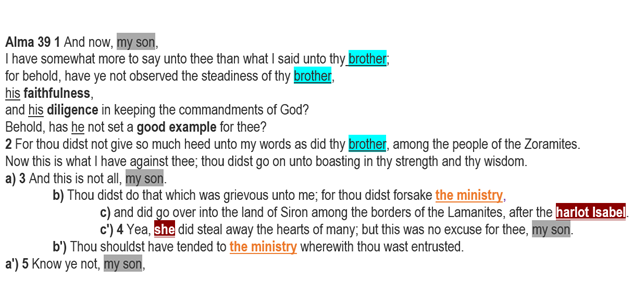
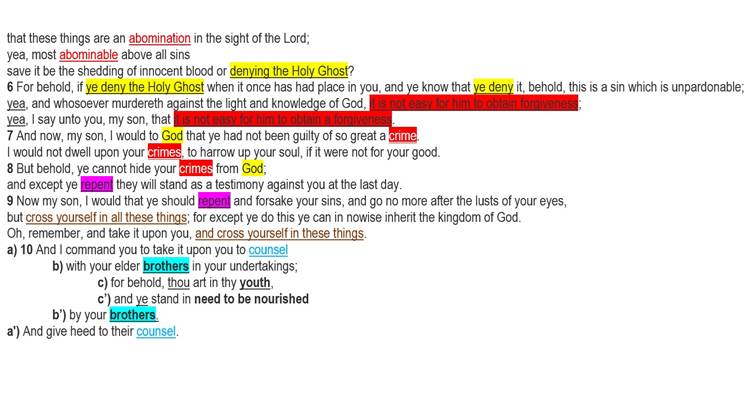
This chapter may have a central focus in Vs 10 to counsel with
your brothers matching the good example of thy brother at the top. It mentions the forsaking of the ministry at
the top and then in Vs 16 mentions the ministry that ye were called to which is
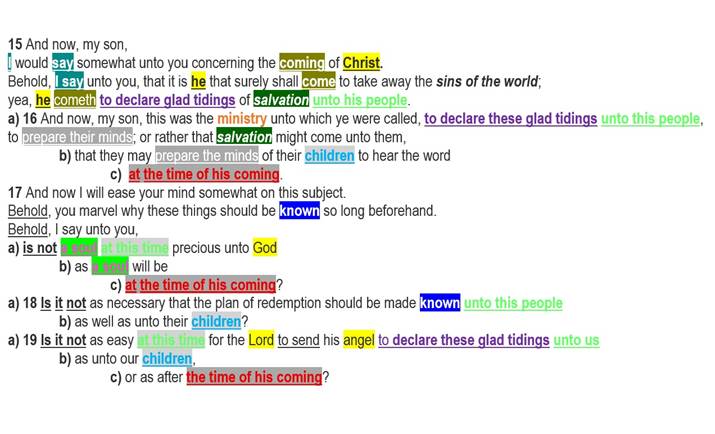
to preach of Christ. The end extended alternate structure may focus on the
concept that the plan of redemption of Christ needs to be preached to his
people before Christ comes, to people at the time when Christ comes, and then in
our day after Christ has come.
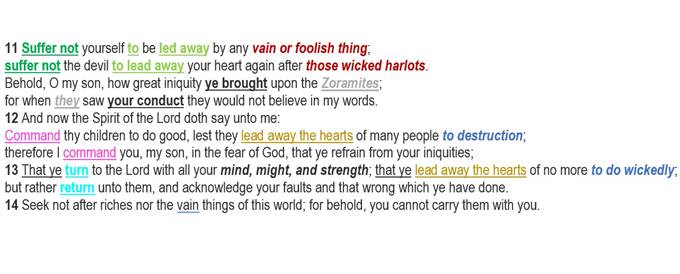
The chapter is composed more of Synonymous double repetition of
statements than Chiasmus or Extended Alternate forms.
Alma 39 1 And
now, my son,
I
have somewhat more to say unto thee than what I said unto thy brother;
for
behold, have ye not observed the steadiness of thy brother,
his faithfulness,
and
his diligence in keeping the commandments of God?
Behold,
has he not set a good example for thee?
2 For thou didst not give so
much heed unto my words as did thy brother,
among the people of the Zoramites.
Now
this is what I have against thee; thou didst go on unto boasting in thy strength and thy
wisdom.
a) 3 And this is not all, my son.
b) Thou didst do that which was grievous
unto me; for thou didst forsake the
ministry,
c) and did go over into the land of Siron among the borders of the Lamanites, after the harlot Isabel.
c') 4 Yea, she did steal away the hearts of many; but this was
no excuse for thee, my son.
b') Thou shouldst have
tended to the ministry wherewith thou wast entrusted.
a') 5 Know ye not, my son,
that
these things are an abomination in
the sight of the Lord;
yea, most abominable above all sins
save it be the shedding of innocent blood or denying the Holy Ghost?
6 For behold, if ye deny the
Holy Ghost when it once has had place in you, and ye know
that ye deny it,
behold, this is a sin which is unpardonable;
yea, and whosoever murdereth against
the light and knowledge of God, it is not easy for him to obtain forgiveness;
yea, I say unto you, my son, that it is not easy for him to obtain a
forgiveness.
7 And now, my son, I
would to God that
ye had not been guilty of so great a crime.
I would not dwell upon your crimes,
to harrow up your soul, if it were not for your good.
8 But behold, ye cannot hide your
crimes from God;
and
except ye repent they
will stand as a testimony against you at the last day.
9 Now my son, I would
that ye should repent and
forsake your sins, and go no more after the lusts of your eyes,
but cross yourself in all these things;
for except ye do this ye can in nowise inherit the kingdom of God.
Oh, remember, and take it upon you, and cross yourself in these things.
a) 10 And I command you to take
it upon you to counsel
b) with your elder brothers in your undertakings;
c) for behold, thou art in thy youth,
c’) and ye stand in need to be
nourished
b’) by your brothers.
a') And give heed to their counsel.
11 Suffer
not yourself to be led
away by any vain or foolish thing;
suffer not the
devil to lead away your
heart again after those wicked harlots.
Behold, O my son, how great iniquity ye brought upon the Zoramites;
for when they saw your conduct they would not believe in my words.
12 And now the Spirit of the
Lord doth say unto me:
Command thy
children to do good, lest they lead away the hearts of
many people to destruction;
therefore I command you, my
son, in the fear of God, that ye refrain from your iniquities;
13 That ye turn to
the Lord with all your mind, might, and strength; that ye lead away the hearts of
no more to do wickedly;
but rather return unto
them, and acknowledge your faults and that wrong which ye
have done.
14 Seek not after riches nor the vain things of
this world; for behold, you cannot carry them with you.
15 And
now, my son,
I would say somewhat unto you
concerning the coming of Christ.
Behold, I say unto
you, that it is he that
surely shall come to take away the sins
of the world;
yea, he cometh to
declare glad tidings of salvation unto his people.
a) 16 And now, my
son, this was the ministry unto which ye were called, to
declare these glad tidings unto
this people,
to prepare their minds; or rather
that salvation might come unto them,
b) that they may prepare the
minds of their children to hear
the word
c)
at the time of his coming.
17 And
now I will ease your mind somewhat on this subject.
Behold,
you marvel why these things should be known
so long beforehand.
Behold,
I say unto you,
a) is not a soul at this time
b) as a soul will
be
c)
at the time of his coming?
a) 18 Is it not
as necessary that the plan of redemption should be made known unto this people
b)
as well as unto their children?
a) 19 Is it not
as easy at this time for
the Lord to send his angel
b) as unto our children,
c) or
as after the time of his coming?
Notice that in 17 he states why these things should
be known, then in the middle or center of the three
extended alternate structures in vs 18 it again repeats the word known as
if this explains that it is necessary that the plan of redemption should be
made known
unto our people as well as those while he lives on the earth or those
after he comes.
Below I’m including images of the text above so Google
can find and show the chiasmus images.