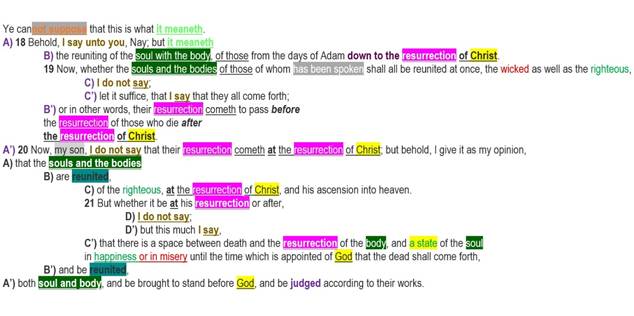
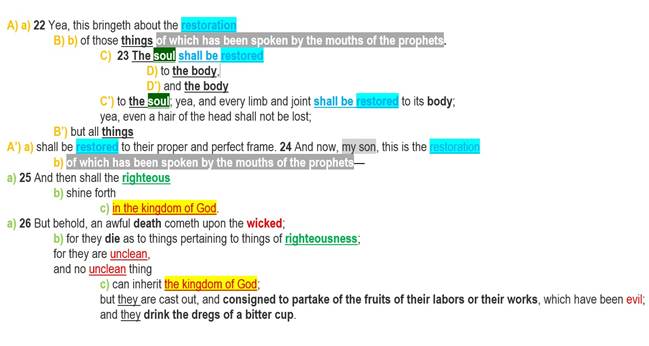
I use indents and letters to show the chiasmus and other forms
and also colors to help highlight the word matches.
In
ancient Hebrew, there were no exclamation points or bold text to show emphasis.
Instead, writers used repetition to convey deep emotion, emphasis, or a
superlative degree.
Chiasmus
(Inverted Parallelism): A mirror-like structure where a sequence of ideas
marches forward to a central climax, and then reverses out in exact backward
order (A-B-C-C'-B'-A'). The main theological point is always placed at the
exact center pivot.
Alternate:
A four-line pattern where the first line matches the third, and the second line
matches the fourth (a-b, a-b)
Extended
Alternate: A six or more-line pattern where the first set of lines
matches the second or more set of lines (a-b-c-d, a-b-c-d)
Synonymous: Line A = Line A' - Reinforces an identity
Antithetical: Line A is an opposite of A - Creates moral or
logical contrast
Climactic:
(Staircase) Parallelism: A key phrase from the first line is repeated at the
start of the second line, stepping up the intensity to deliver a brand-new,
dramatic climax at the end of the thought.
Anaphora:
The strict repetition of the exact same word or phrase at the beginning
of successive sentences or parallel lines to accumulate emotional momentum.
Epistrophe:
The repetition of the exact same word or phrase at the end of successive
statements, creating a rhythmic, echoing refrain (such as the repetition of "this
thing" and “unto thee” in Alma 41:1-2).
Symploce:
A masterful combination of both anaphora and epistrophe, where successive lines
begin with the exact same words and end with the exact same words,
varying only the middle content.
Epizeuxis
(Reduplication): The immediate, back-to-back repetition of a single word or
name with no words in between (e.g., "Abraham, Abraham" or "Holy,
holy, holy") used to denote urgency or the highest possible
superlative.
Anadiplosis:
A chain-linking form where the final word of one poetic line is used as the
very first word of the next poetic line, tying the progression of thoughts
together like links in a chain.
Synthetic: (also
known as progressive parallelism) A poetic form where the second line of a
verse does not repeat or contrast the first line. Instead, it physically builds
upon the first line, adding new information, explanations, or context to
complete and advance the thought.
Though there are several individual forms throughout the chapter
it’s possible that there is an overarching conceptual chiasmus form as follows
below.
A — Resurrection has not
yet come; Alma has inquired of God concerning it (vv. 1–3)
B — There is an appointed time when the dead shall rise (vv.
4–10)
C — There is a space between death and
resurrection (vv. 6–10)
D — Inquiry of what happens to the
souls during that space then made known by and angel? (v. 7-11)
D′ — The state of the souls
during that space is revealed (vv. 11–14)
C′ — The souls remain in happiness or
misery until resurrection (vv. 15–16)
B′ — Resurrection means the reunion of soul and body
(vv. 18–21)
A′ — Resurrection/restoration brings all things to their proper
and perfect frame (vv. 22–26)
I would not insist that this is a strict chiasm,
because rather than simply mirroring vv. 4–10’s A/B/C structure, the four
chiasmus structures in Alma 40:15–21 develops an important doctrinal
clarification. As a macro-literary structure, this is considerably stronger
than treating every repeated phrase as an A/B/C correspondence.
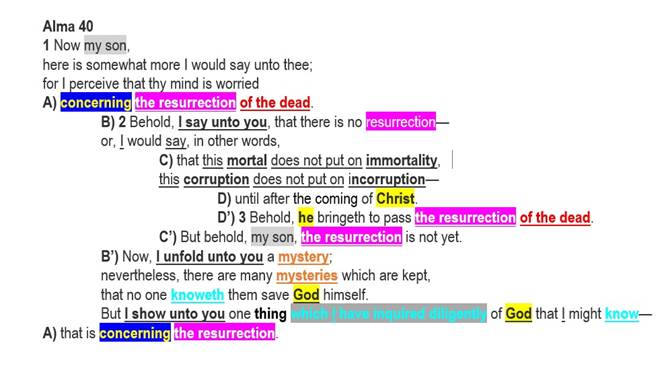
Alma 40
1 Now my son,
here
is somewhat more I would say unto thee;
for
I perceive that thy mind is worried
A) concerning the resurrection of the dead.
B) 2 Behold, I say unto
you, that there is no resurrection—
or, I would say,
in other words,
C) that this mortal does
not put on immortality,
this corruption does not put on incorruption—
D) until after the
coming of Christ.
D’) 3 Behold, he bringeth to pass the resurrection of
the dead.
C’) But behold, my son,
B’) Now, I unfold unto you
a mystery;
nevertheless,
that no one knoweth them
But I show unto you one thing which I have inquired diligently of God that I might know—
A) that is concerning the resurrection.
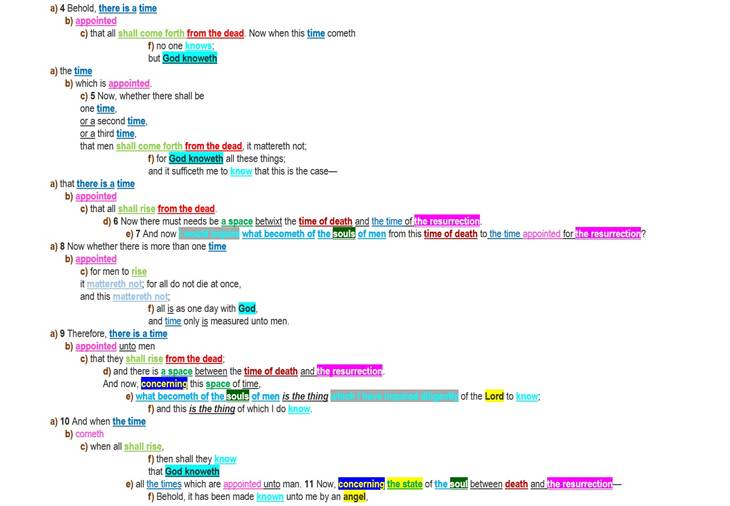
a) 4 Behold, there
is a time
b) appointed
c) that
all shall come forth from
the dead.
f) no
one knows;
but God knoweth
a) the time
b) which
is appointed.
c) 5 Now, whether there shall be
one time,
or a second time,
or a third time,
that men shall come forth from
the dead, it mattereth not;
f) for God knoweth all
these things;
and it sufficeth me to know that
this is the case—
a) that there
is a time
b) appointed
c) that
all shall rise from
the dead.
d) 6 Now
there must needs be a space betwixt
the time of death and the
time of the resurrection.
e) 7 And
now I would inquire what becometh of the souls of
men from this time
of death to the time appointed
for the resurrection?
a) 8 Now whether there is more
than one time
b) appointed
c) for
men to rise
it mattereth not;
for all do not die at once,
and this mattereth not;
f) all is as one day with God,
and time only is measured
unto men.
a) 9 Therefore, there
is a time
b) appointed unto men
c) that
they shall rise from
the dead;
d) and
there is a space between the time
of death and the resurrection.
And now, concerning this
space of time,
e) what becometh of the souls of men is
the thing which
I have inquired diligently of the Lord to know;
f) and
this is the thing of which I do know.
a) 10 And when the
time
b) cometh
c) when
all shall rise,
f) then
shall they know
that God knoweth
e) all the times which are appointed
unto man.
f) Behold, it has been made known unto
me by an angel,
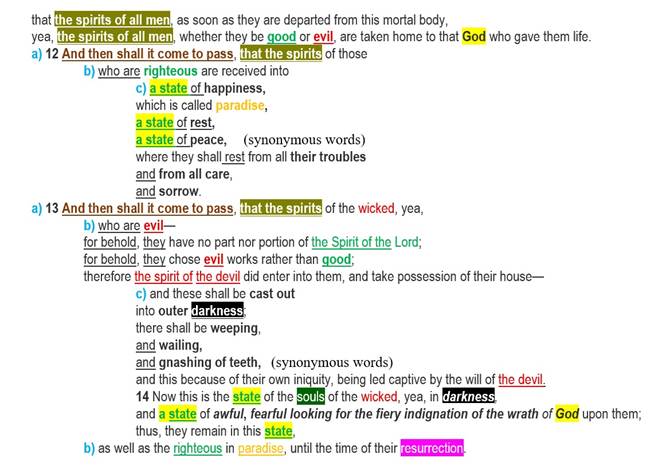
that the spirits of
all men, as soon as they are departed from this mortal body,
yea, the spirits of all men,
whether they be good or evil,
are taken home to
that God who
gave them life.
a) 12 And then shall it come to
pass, that the spirits of those
b) who are righteous are
received into
c) a state of happiness,
which is called paradise,
a state of rest,
a state of peace, (synonymous words)
where they shall rest from all their
troubles
and from all care,
and sorrow.
a) 13 And then shall it come to
pass, that the spirits of
the wicked, yea,
b) who are evil—
for behold, they
have no part nor portion of the Spirit of the Lord;
for behold, they chose evil works
rather than good;
therefore the spirit of the devil did enter into them, and
take possession of their house—
c) and
these shall be cast out
into outer darkness;
there shall be weeping,
and wailing,
and gnashing of teeth, (synonymous words)
and this because of their own iniquity, being led captive by the
will of the devil.
14 Now this is the state of
the souls of
the wicked,
yea, in darkness,
and a state of awful, fearful looking for the fiery indignation of the wrath of God upon
them;
thus, they remain in this state,
b)
as well as the righteous in paradise,
until the time of their resurrection.
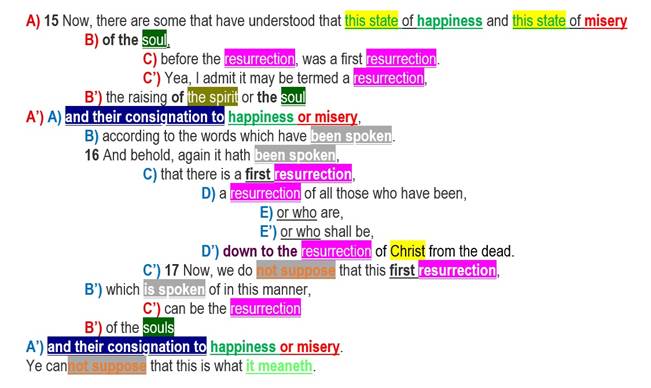
A) 15 Now, there are some that
have understood that this
state of happiness and this state of misery
B) of
the soul,
C) before
the resurrection,
was a first resurrection.
C’) Yea,
I admit it may be termed a resurrection,
B’) the raising of the spirit or the soul
A’) A)
and
their consignation to happiness
or misery,
B) according
to the words which have been spoken.
16 And behold, again it
hath been
spoken,
C) that
there is a first resurrection,
D) a resurrection of all those who have been,
E) or
who are,
E’) or
who shall be,
D’) down
to the resurrection of Christ from the dead.
C’) 17 Now,
we do not
suppose that this first
resurrection,
B’) which is spoken of in this manner,
C’) can
be the resurrection
B’) of
the souls
A’) and their consignation to happiness or
misery.
Ye
cannot
suppose that this is what it meaneth.
A) 18 Behold,
B)
the reuniting of the soul with the body, of
those from the days of Adam down to the resurrection of Christ.
19 Now, whether the souls and the
bodies of those
of whom has
been spoken shall all be reunited at
once, the wicked as well as the righteous,
C) I do not say;
C’)
let it suffice,
B’) or
in other words, their resurrection cometh to
pass before
the resurrection of those who die after
the resurrection of Christ.
A’) 20 Now, my son,
A) that the souls and the
bodies
B)
are reunited,
C)
of the righteous, at the resurrection of Christ, and his ascension into heaven.
21 But whether it be at his resurrection or after,
D) I do not say;
D’) but
this much I say,
C’) that
there is a space between death and the resurrection of the body, and
a state of
the soul
in happiness or in misery until the time which is appointed of God that the dead shall come forth,
B’)
and be reunited,
A’) both soul and body,
and be brought to stand before God, and be judged according
to their works.
A) a) 22 Yea, this bringeth about the restoration
B)
b) of those things of which has been spoken by the mouths of
the prophets.
C) 23 The soul shall
be restored
D) to the body,
D’) and the
body
C’) to the
soul;
yea, and every limb and joint shall be restored to
its body;
yea, even a hair of
the head shall not be lost;
B’) but
all things
A’) a) shall be restored to
their proper and perfect frame.
b)
of
which has been spoken by the mouths of the prophets—
a) 25 And
then shall the righteous
b)
shine forth
c)
in the kingdom of God.
a) 26 But
behold, an awful death cometh upon the wicked;
b) for
they die as to things pertaining to things of righteousness;
for they are unclean,
and no unclean thing
c)
can inherit the kingdom of God;
but they are cast out, and consigned to
partake of the fruits of their labors or their works, which have been evil;
and they drink the dregs of a bitter cup.
Below I’m including images of the text above so Google
can find and show the chiasmus images.