I use indents and letters to show the chiasmus and other forms
and also colors to help highlight the word matches.
In
ancient Hebrew, there were no exclamation points or bold text to show emphasis.
Instead, writers used repetition to convey deep emotion, emphasis, or a
superlative degree.
Chiasmus
(Inverted Parallelism): A mirror-like structure where a sequence of ideas
marches forward to a central climax, and then reverses out in exact backward
order (A-B-C-C'-B'-A'). The main theological point is always placed at the
exact center pivot.
Alternate:
A four-line pattern where the first line matches the third, and the second line
matches the fourth (a-b, a-b)
Extended
Alternate: A six or more-line pattern where the first set of lines
matches the second or more set of lines (a-b-c-d, a-b-c-d)
Synonymous: Line A = Line A' - Reinforces an identity
Antithetical: Line A is an opposite of A - Creates moral or
logical contrast
Climactic:
(Staircase) Parallelism: A key phrase from the first line is repeated at the
start of the second line, stepping up the intensity to deliver a brand-new,
dramatic climax at the end of the thought.
Anaphora:
The strict repetition of the exact same word or phrase at the beginning
of successive sentences or parallel lines to accumulate emotional momentum.
Epistrophe:
The repetition of the exact same word or phrase at the end of successive
statements, creating a rhythmic, echoing refrain (such as the repetition of "this
thing" and “unto thee” in Alma 41:1-2).
Symploce:
A masterful combination of both anaphora and epistrophe, where successive lines
begin with the exact same words and end with the exact same words,
varying only the middle content.
Epizeuxis
(Reduplication): The immediate, back-to-back repetition of a single word or
name with no words in between (e.g., "Abraham, Abraham" or "Holy,
holy, holy") used to denote urgency or the highest possible
superlative.
Anadiplosis:
A chain-linking form where the final word of one poetic line is used as the
very first word of the next poetic line, tying the progression of thoughts
together like links in a chain.
Synthetic: (also
known as progressive parallelism) A poetic form where the second line of a
verse does not repeat or contrast the first line. Instead, it physically builds
upon the first line, adding new information, explanations, or context to
complete and advance the thought.
There are overlapping chiasmus structures in this
chapter that are very interesting. At
the top I’m separating all the chiasmus forms to make them easier to see. Below
that, I’m placing the entire chapter without the overlapping structures to make
it possible to read straight through the chapter. I did some further markings in the top forms
and thus the continuous reading text does not exactly match the top. At bottom
I’ve added images of text so Google can find images for search.
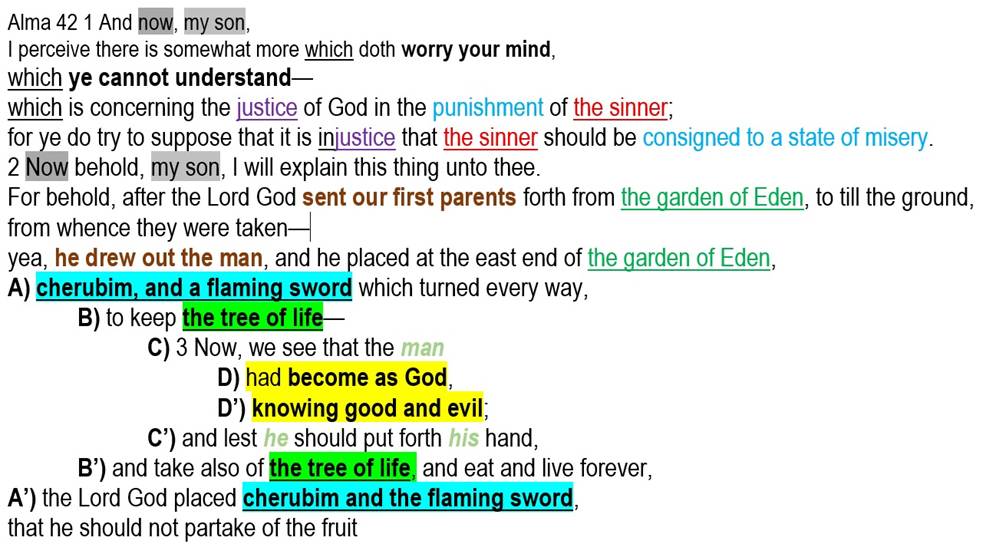
Notice that the center of the first chiasmus has
similarities to the Bible below
Genesis 3:22 And the Lord God said,
Behold, the man is become as one of us,
to know good and evil:
Alma 42 1 And now, my son,
I perceive there is somewhat more which doth worry
your mind,
which ye cannot understand—which is
concerning
the justice of God in the punishment
of the sinner;
for ye do try to suppose that it
is injustice that the sinner should
be consigned to a state of misery.
2 Now behold, my son, I will explain this thing unto thee.
a) For behold, after the Lord God sent
our first parents
b) forth from the garden of Eden, to till the ground, from whence they were taken—
a) yea, he drew out the
man,
b) and he
placed at the east end of the garden of Eden,
A) cherubim, and a flaming sword which
turned every way,
B) to keep the
tree of life—
C) 3 Now,
we see that the man
D) had become as
God,
D’) knowing
good and evil;
C’) and lest he should
put forth his hand,
B’) and take also
of the tree of life, and eat and live forever,
A’) the Lord God
placed cherubim and the flaming
sword,
A) and
take also of the tree of life, and eat and live
forever,
the Lord God placed cherubim
and the flaming sword,
B) that he should not partake of
the fruit—4 And thus we see,
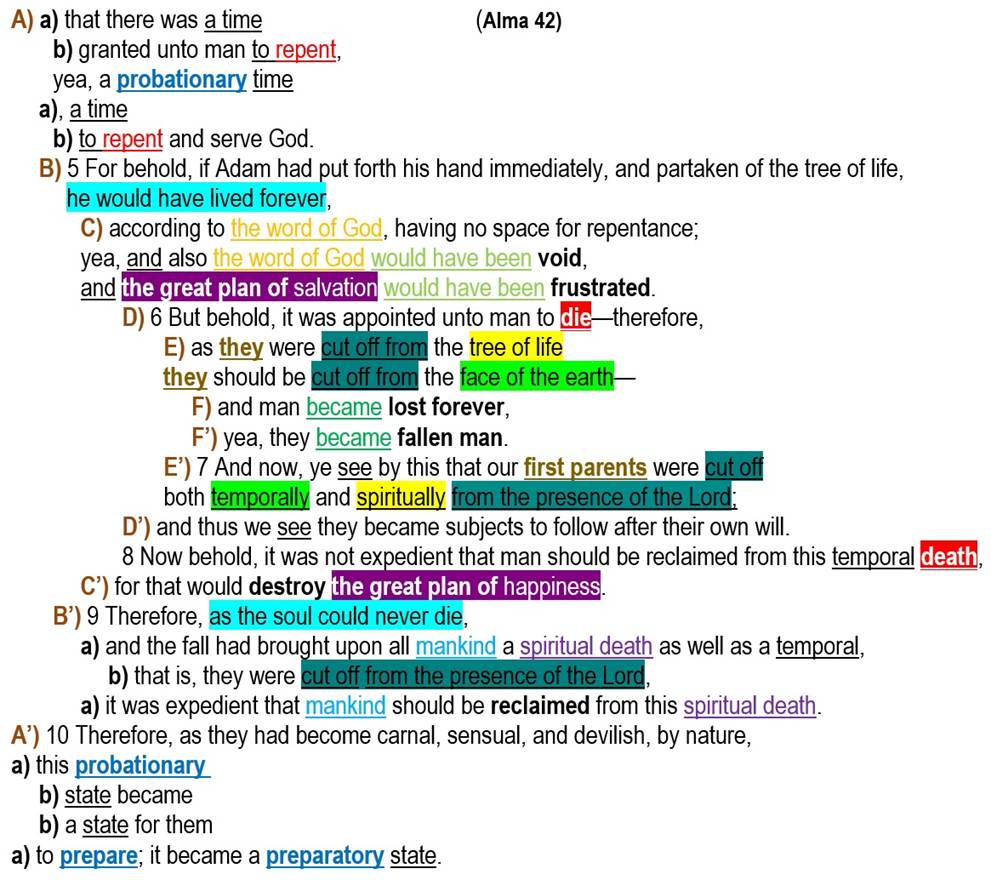
C) a) that there was a time
b) granted
unto man to repent,
yea, a probationary time
C’) a), a
time
b) to repent and
serve God.
B’) 5 For
behold, if Adam had put forth his hand immediately, and partaken
A’) of the
tree of life, he would have lived forever,
A) a) 4 And
thus we see, that there was a time
b) granted unto man to repent,
yea, a probationary time
a), a time
b) to repent and
serve God.
B) 5 For
behold, if Adam had put forth his hand immediately, and partaken of the
tree of life,
he would have lived forever,
C’) according to the
word of God, having no space for repentance;
yea, and also the
word of God would have been void,
and the great plan
of salvation would have been frustrated.
D) 6 But
behold, it was appointed unto man to die—therefore,
E) as they were cut off from the tree of life {Spiritual
Death}
they should be cut off from the face of the earth— {Temporal Death}
F) and man became lost
forever,
F’) yea, they became fallen
man.
E’) 7 And now,
ye see by this that our first parents were cut off
both temporally and spiritually from the presence of the Lord;
D’) and thus we see they became
subjects to follow after their own will.
8 Now
behold, it was not expedient that man should be reclaimed from this temporal death,
C’) for that would destroy the great plan
of happiness.
B’) 9 Therefore,
as the soul could never die,
a) and
the fall had brought upon all mankind a spiritual death as
well as a temporal,
b) that is, they were cut off from
the presence of the Lord,
a) it
was expedient that mankind should
be reclaimed from this spiritual death.
A’) 10 Therefore, as they had become carnal,
sensual, and devilish, by nature,
a) this probationary
b) state became
b) a state for
them
a) to prepare; it
became a preparatory state.
A) 10 Therefore, as they had become carnal,
sensual, and devilish, by nature,
a) this probationary
b) state became
b) a state for
them
a) to prepare; it
became a preparatory state.
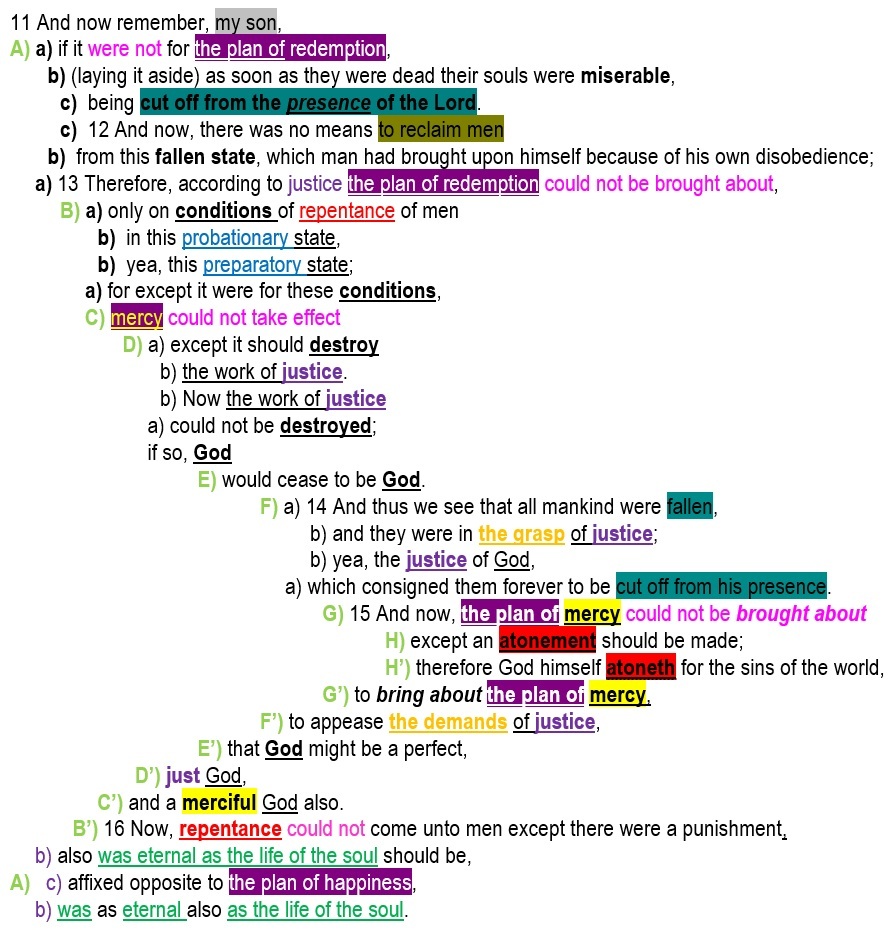
B) a) 11 And now remember, my son, if it were not for the plan of redemption,
C) (laying
it aside) as soon as they were dead their souls were miserable,
D) being
cut off from the presence of the Lord.
D’) 12 And now, there was no means to reclaim men
C’) from
this fallen state, which man had brought upon
himself because of his own disobedience;
B’) a) 13 Therefore,
according to justice the plan of redemption could
not be brought about,
A’) a) only on conditions of repentance of
men
b) in this
probationary state,
b) yea,
this preparatory state;
a) for
except it were for these conditions,
mercy could not take effect
11 And
now remember, my son,
A) a) if it were not for the plan of redemption,
b) (laying
it aside) as soon as they were dead their souls were miserable,
c) being cut off from the presence of
the Lord.
c) 12 And now, there was no means to reclaim
men
b) from
this fallen state, which man had brought upon
himself because of his own disobedience;
a) 13 Therefore, according to justice the plan of redemption could
not be brought about,
B) a) only
on conditions of repentance of
men
b) in this probationary
state,
b) yea, this preparatory
state;
a) for
except it were for these conditions,
C) mercy could not take effect
D) a) except it should destroy
b) the
work of justice.
b) Now the work of justice
a) could not be destroyed;
if so, God
E) would
cease to be God.
F) a) 14 And
thus we see that all mankind were fallen,
b) and they were in the grasp of justice;
b) yea, the justice of God,
a) which consigned them forever to be cut off from his presence.
G) 15 And now, the plan of mercy could
not be brought about
H) except
an atonement should
be made;
H’) therefore
God himself atoneth for
the sins of the world,
G’) to
bring about the plan of mercy,
F’) to
appease the demands of justice,
E’) that God might
be a perfect,
D’) just God,
C’) and
a merciful God also.
B’) 16 Now, repentance could
not come unto men except there were a punishment,
b) also
was eternal as the life of the soul should
be,
A) c) affixed
opposite to the plan of happiness,
b) was as eternal
also as the life of the soul.
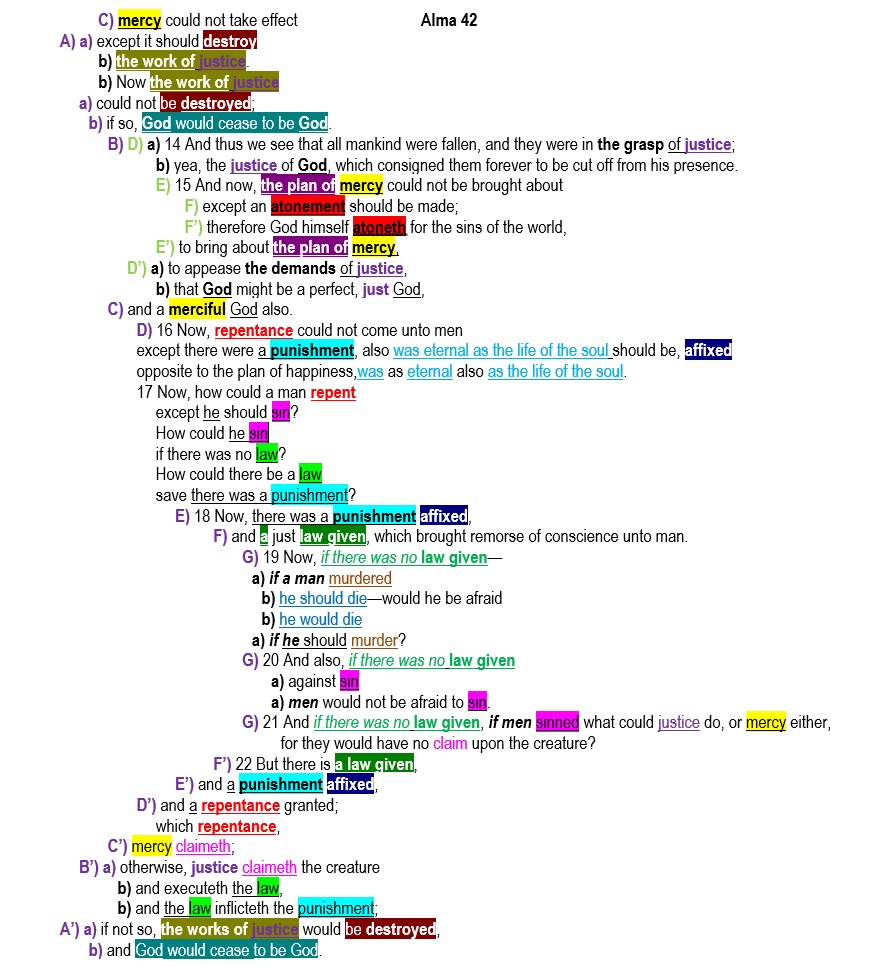
mercy could
not take effect
A) a) except it
should destroy
b) the work of justice.
b)
Now the work of justice
a) could not be destroyed;
b) if
so, God would
cease to be God.
B) 14 And thus we see that all mankind were
fallen, and they were in the grasp of justice;
yea, the justice of God, which consigned them
forever to be cut off from his presence.
C) 15 And now, the plan of mercy could not be brought
about
except an atonement should
be made;
therefore God himself atoneth for the sins of the world,
to bring about the plan
of mercy,
to appease the demands of justice,
that God might be a perfect, just God,
and a merciful God also.
D) 16 Now, repentance could
not come unto men
except there were a punishment, also was
eternal as the life of the soul should
be, affixed
opposite to the plan of happiness,was as eternal
also as the life of the soul.
17 Now,
how could a man repent
except he should sin?
How could he sin
if there was no law?
How could there be a law
save there was a punishment?
E) 18 Now, there was a punishment affixed,
F) and a
just law given, which brought remorse of
conscience unto man.
G) 19 Now, if there was no law given—
a) if a
man murdered
b) he should die—would
he be afraid
b) he
would die
a) if he
should murder?
G) 20 And also, if there was no law given
a) against sin
a) men would
not be afraid to sin.
G) 21 And if there was no law given, if
men sinned what
could justice do, or mercy either,
for they would have no claim upon the creature?
F) 22 But there is a law given,
E’) and a punishment affixed,
D’) and a repentance granted;
which repentance,
C’) mercy claimeth;
B’) a) otherwise, justice claimeth the
creature
b) and executeth the law,
b) and the law inflicteth
the punishment;
A’) a) if not so, the works of justice would be destroyed,
b) and God would
cease to be God.
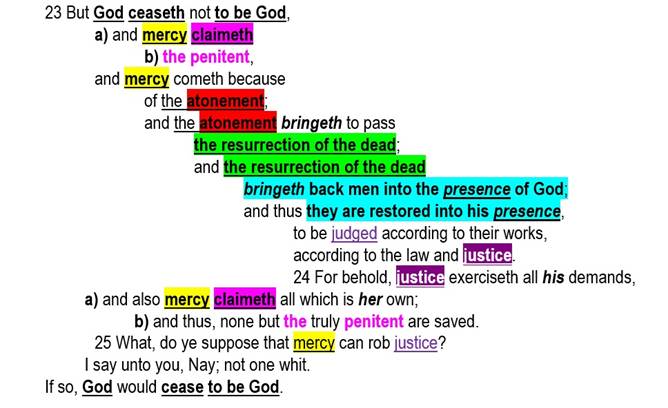
23 But God ceaseth not to
be God,
a) and mercy claimeth
b) the penitent,
and mercy cometh because
of the atonement;
and the atonement bringeth to
pass
the
resurrection of the dead;
and the resurrection
of the dead
bringeth back men into
the presence of God;
and thus they are restored into his presence,
to be judged according
to their works,
according to the law and justice.
24 For
behold, justice exerciseth all his demands,
a) and
also mercy claimeth all
which is her own;
b) and
thus, none but the truly penitent are saved.
25 What,
do ye suppose that mercy can
rob justice?
I say unto you, Nay; not one whit.
If so, God would
cease to be God.
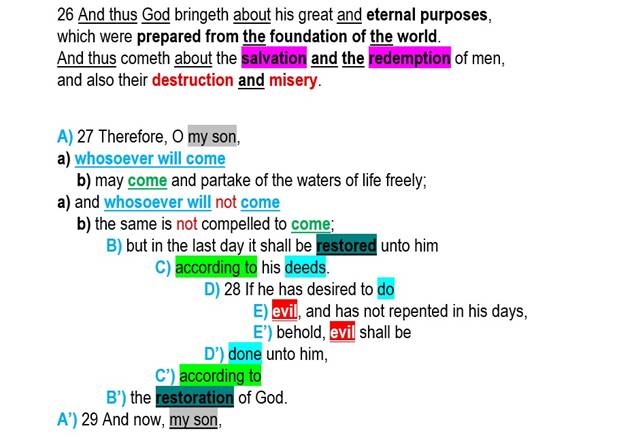
26 And
thus God bringeth about his
great and eternal purposes,
which were prepared from the foundation
of the world.
And thus cometh about the salvation and the redemption of
men,
and also their destruction and misery.
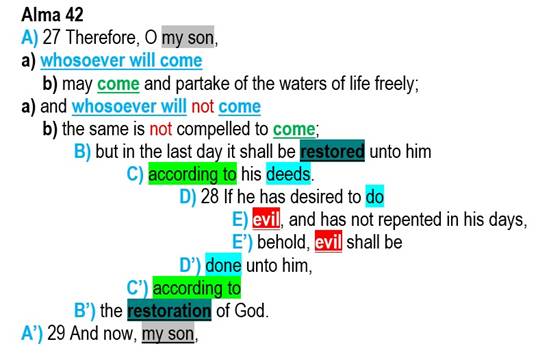
A) 27 Therefore,
O my son,
a) whosoever
will come
b) may come and
partake of the waters of life freely;
a) and whosoever
will not come
b) the
same is not compelled to come;
B) but in the last day it shall be restored unto him
C) according to his deeds.
D) 28 If
he has desired to do
E) evil, and has not repented in his days,
E’) behold, evil shall be
D’) done
unto him,
C’) according
to
B’) the restoration of God.
A’) 29 And
now, my son,
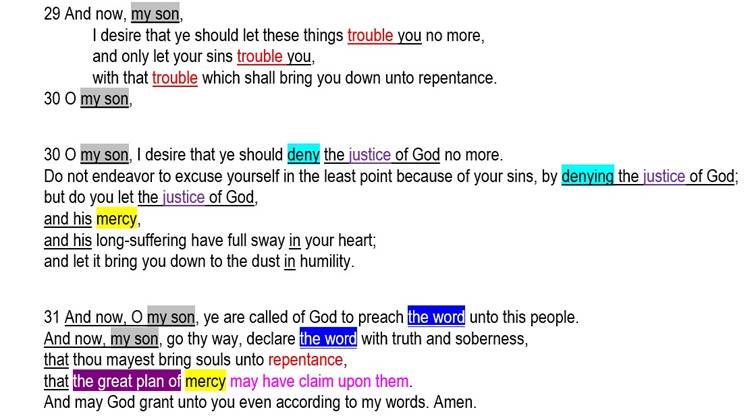
29 And
now, my son,
I desire that ye should let these things trouble
you no more,
and only let your sins trouble you,
with that trouble which
shall bring you down unto repentance.
30 O my son,
30 O my son, I desire that ye should deny the justice of
God no more.
Do not endeavor to excuse yourself in
the least point because of your sins, by denying the justice of
God;
but do you let the justice of
God,
and his mercy,
and his long-suffering
have full sway in your heart;
and let it bring you down to the
dust in humility.
31 And
now, O my son, ye
are called of God to preach the word unto
this people.
And now, my son, go thy way, declare the word with
truth and soberness,
that thou mayest
bring souls unto repentance,
that the great plan of mercy may have claim upon them.
And may God grant unto you even
according to my words. Amen.
_____________________________________________________________________________________________________
Alma 42 1 And now, my son,
I perceive there is somewhat more which doth worry
your mind,
which ye cannot understand—which is
concerning
the justice of God in the punishment
of the sinner;
for ye do try to suppose that it
is injustice that the sinner should
be consigned to a state of misery.
2 Now behold, my son, I will explain this thing unto thee.
For behold, after the Lord God sent
our first parents forth from the garden of Eden, to till the
ground,
from whence they were taken—yea, he drew
out the man, and he placed at the east end of the garden of Eden,
cherubim, and a flaming sword which turned every way,
to
keep the tree of life—
3 Now,
we see that the man
had
become as God,
knowing good and evil;
and
lest he should put forth his hand,
A) and take also of the tree of life, and eat and live forever,
the Lord God placed cherubim
and the flaming sword,
B) that he should not partake of the fruit—4 And thus we
see,
C) A) a) that
there was a time
b) granted unto man to repent,
yea,
a probationary time
C’) a), a time
b) to repent and
serve God.
B’) 5 For behold, if Adam had put forth his hand
immediately, and partaken
A’) of the tree of life, he would have lived forever,
B) according to the word of God, having no space
for repentance;
yea, and also the
word of God would have been void,
and the great plan of
salvation would have been frustrated.
C) 6 But behold, it was appointed unto man to die—therefore,
D) as they were cut off from the tree of life
they should
be cut off from the face of
the earth—
E) and man became lost forever,
E’) yea, they became fallen man.
D’) 7 And now, ye see by this that our
first parents were cut off both temporally and spiritually from the presence of the Lord;
C’) and thus we see they became subjects to
follow after their own will.
8 Now
behold, it was not expedient that man should be reclaimed from this temporal death,
B’) for that would destroy the great plan
of happiness.
9 Therefore,
as the soul could never die, and the fall had brought upon all mankind a spiritual death as well as a temporal, that is
, they
were cut off from the presence of the Lord, it
was expedient that mankind should be reclaimed from this spiritual death.
A’) 10 Therefore, as they had become
carnal, sensual, and devilish, by nature,
this probationary state became a state for
them to prepare;
it became a preparatory state.
11 And now remember, my son,
if it were not for the plan of redemption, (laying it aside) as soon as they
were dead their souls were miserable,
being cut off from the presence of the Lord.
12 And
now, there was no means to reclaim men from
this fallen state, which man had brought upon
himself because of his own disobedience;
13 Therefore,
according to justice, the plan of redemption could not be brought about,
only
on conditions
of repentance of men
in this
probationary state,
yea,
this preparatory state;
for
except it were for these conditions,
A) mercy could not take effect
a)
except it should destroy
B) V) b) the work of justice. Now
b) the
work of justice
a) could
not be destroyed;
C) if so, God would cease to be God.
D) 14 And thus we see that all mankind were fallen, and
they were in the grasp of justice;
yea,
the justice of God, which
consigned them forever to be cut off from his presence.
E) 15 And now, the plan of mercy could not be brought about
F) except an atonement should
be made;
G) therefore God himself
F’) atoneth for the sins of the world,
E’) to bring about the plan of mercy,
D’) to appease the demands of justice,
C’) that God might be a perfect,
B’) just God,
A’) W) and a merciful God also.
X) 16 Now, repentance could
not come unto men
Y) a) except
there were a punishment,
b) also was eternal as the life
of the soul should be,
c) affixed opposite to the plan of
happiness,
b) was as eternal also as the
life of the soul.
X) 17 Now, how could a man repent
except he should sin?
How
could he sin
if there
was no law?
How
could there be a law
Y) a) save there was a punishment?
18 Now, there
was a punishment affixed,
Z) and a just law given, which brought remorse of
conscience unto man.
a)
19 Now, if there was no law
given—
b) if
a man murdered
c) he
should die—would he be afraid
c) he
would die if
he should
b) murder?
a)
20 And also, if there was no law
given
b) against sin
b) men
would not be afraid to sin.
a)
21 And if there was no law
given, if men sinned what
could justice do, or mercy either, for they would have no
claim upon the creature?
Z’) 22 But there is a law given,
Y’) and a punishment affixed,
X’) and a repentance granted;
which repentance,
W’) mercy claimeth; otherwise,
V’) justice claimeth the
creature
Z’) and executeth the law,
and the law inflicteth
Y’) the punishment;
V’) if not so, the works of justice would be destroyed,
C) and God would cease to be God.
C’) 23 But God ceaseth not to be
God,
A)and mercy claimeth the
penitent,
A’)and mercy cometh because
F) of the atonement;
F’) and the atonement bringeth
to pass
the resurrection of the dead;
and the resurrection of the dead
bringeth back
men into the presence of God;
and thus they
are restored into his presence,
to be judged according
to their works,
according to the law and justice.
24 For behold, justice exerciseth all his demands,
and also mercy claimeth all which
is her own; and thus, none but the truly penitent are
saved.
25 What, do ye suppose that mercy can rob justice? I say unto you, Nay; not one whit.
C) If so, God would
cease to be God.
26 And thus God bringeth about his
great and eternal purposes,
which were prepared from the foundation
of the world.
And thus cometh about the salvation and the redemption of
men,
and also
their destruction and misery.
27 Therefore, O my son, whosoever will come may come and
partake of the waters of life freely;
and whosoever will not come the
same is not compelled to come;
but in the last day it shall be restored unto him according to his
deeds.
28 If
he has desired to do evil,
and has
not repented in his days,
behold, evil shall
be done unto him,
according to the restoration of God.
29 And now, my son,
I desire
that ye should let these things trouble you no more,
and only
let your sins trouble you,
with
that trouble which shall bring you down unto repentance.
30 O my son, I desire that ye should deny the justice of God no more.
Do not endeavor to excuse yourself in
the least point because of your sins,
by denying the justice of God;
but do you let the justice of God,
and his mercy,
and his long-suffering have full
sway in your heart;
and let it bring you down to the
dust in humility.
31 And now, O my son, ye are called of God to
preach the word unto this people.
And now, my son, go thy way,
declare the word with truth and soberness,
that thou mayest bring souls unto repentance,
that the great plan of mercy may have claim upon
them.
And may God grant unto you even
according to my words. Amen.
Below I’m including images of the text above so Google
can find and show the chiasmus images.